When to Get With Your Friend’s Ex
Since I was in fifth or sixth grade, I’ve kept a notes document called “List of things that will be important for life as an adult and for future children.” Every time I learned a lesson, or noticed some misconception other people held that I had come to think more carefully about, I wrote it down so my kids wouldn’t fall into the same traps I did. Up until the last note I wrote, around when I entered college, that list was over 14,000 words of small notes.
Perhaps that’s what led me to appreciating How I Met Your Mother, a show I’ve held very dear to me ever since I watched it for the first time in the fall of 2022. In that show, Barney Stinson writes the Playbook, a list of one-page plays for how to get girls, and the Bro Code, a sort of law for how to treat your “bros.” Those two books are what inspired me to write one of my own.
I went through a major transitional period in early 2025. I’ve written a lot about how I never felt I fit in with many societal norms, from middle school to high school to college. In middle school, I was trying my best to listen to all the rap music that I thought would make me cool. Naturally, I assumed something was wrong with me because I wasn’t listening to that music beforehand and that this was the reason the popular kids weren’t friends with me. Later in high school I understood myself a lot better, met a lot more people who appreciated me without just rap music, but I still didn’t really understand myself to any extent that it was really applicable in my life. I always had some sense that who I was didn’t feel like me, but the solution always seemed to be just to tailor myself to societal norms and not worry too much about that.
In my last post I talked about an essay I wrote my freshman year of college. I said something vague in it about having my own company and being successful someday, with no idea how I’d get there. It was another version of the person I thought I should be, except this one came from my family’s history, so it seemed more “made for me” than just conforming. Freshman and sophomore year didn’t go that way. I wasn’t successful in recruiting, I didn’t find friends that matched me, and I wasn’t at a school that made sense for me. A lot of that, in hindsight, was my fault, but it’s the conclusion I came to.
Come summer 2025, I finally had the chance to step back and look at my life at a high level. Not just to see that it wasn’t what I wanted, but to look into why. Then I just started doing more of the things that, to my knowledge, I enjoyed.
That led me back to How I Met Your Mother. I watched it in an entirely different light and caught so many of the subtle moments I could never have seen three years earlier.
One of the first “lessons” stated in the show is “Nothing good happens after 2am.” I loved these little lessons because they reminded me of my own list I’d kept, so I looked up the full list of ones online and noted them down in my document and kept watching. Many of the lessons in the show were more unserious, but there was always a bit of truth in them, and so many of those I noticed in my own life. As I watched, whenever the show didn’t make a rule where I felt one could fit, or I had some theory about life, I’d write it down. Very soon that turned into a pretty long list of:
- How to be a wingman for your friends
- Theories on human psychology labeled in ways that fit my own life, like the Sparkling Water Theory
- How to recover from a breakup
Those each turned into these one-page articles, basically explaining how to do things or not to do them, or explaining the theory itself. In my eyes this was the HIMYM-ified version of the notes document for my kids. Except I saw this as going beyond just my kids: it could apply to friends of mine who were in bad situations where you would never realize you were in it from the inside, but from the outside it’s super obvious. It became the thing I wish I had in my life like 3 years earlier. Watching How I Met Your Mother again gave me a form of catharsis, and that’s what I really hoped a book like this could do, through a sort of indirect transmission via the jokes.
A lot of the articles are very unserious. A lot of them make hard fixed rules about things you most certainly cannot (and probably should not) make a rule about. What I noticed as I wrote them was that I’d get so many people’s opinions, and so many people pushing back. That helped me get more specific in the book’s thinking and in my own, because these were my own opinions, formulations I’d built over so many years of my life. Writing them down gave my words this artificial sense of authority over what’s right or wrong, and that encouraged people to look at them with a scrutiny they’d normally keep to themselves and I really appreciated that.
The fall of 2025 I left to study abroad in Barcelona. As much as I loved every moment of going to Barça games, seeing the most beautiful places I had ever seen, and making amazing lifelong friends, the root of what made it so valuable was being completely disconnected from the previous direction my life had been going in at Rice. I didn’t have commitments to friends, to situations, to existing social circles. I had the chance to restart, and I felt like a freshman in college again (and this time knowing not to try to make a fraternity!).
But in my alone time, I kept watching How I Met Your Mother, and kept adding to my Google Doc of rules and theories of life. And through my, let’s say, “troubled” adventures to meet the mother of my children in the clubs of Barcelona, I had plenty of moments of catharsis myself that gave me new theories and rules of my own to add.
In November of that year, I got a FaceTime from my brother. He told me our mom had told him I’d written a playbook for women. Despite taking immediate offense due to my belief that the Lantern had so much more in it than just relationships, I heard him out.
He was calling because he had a question, the title of this article: what do you do when you have a thing for your friend’s ex?
I wish I remembered exactly what I had written at that point, but it was basically stating that after a time frame relative to the length of the relationship, it’s always fine to get with your friend’s ex. Hearing how complicated my brother’s situation was made me get more specific, though, and I made an equation that seemed to check out for the scenarios I was playing through in my head with my own friends, and for my brother’s:
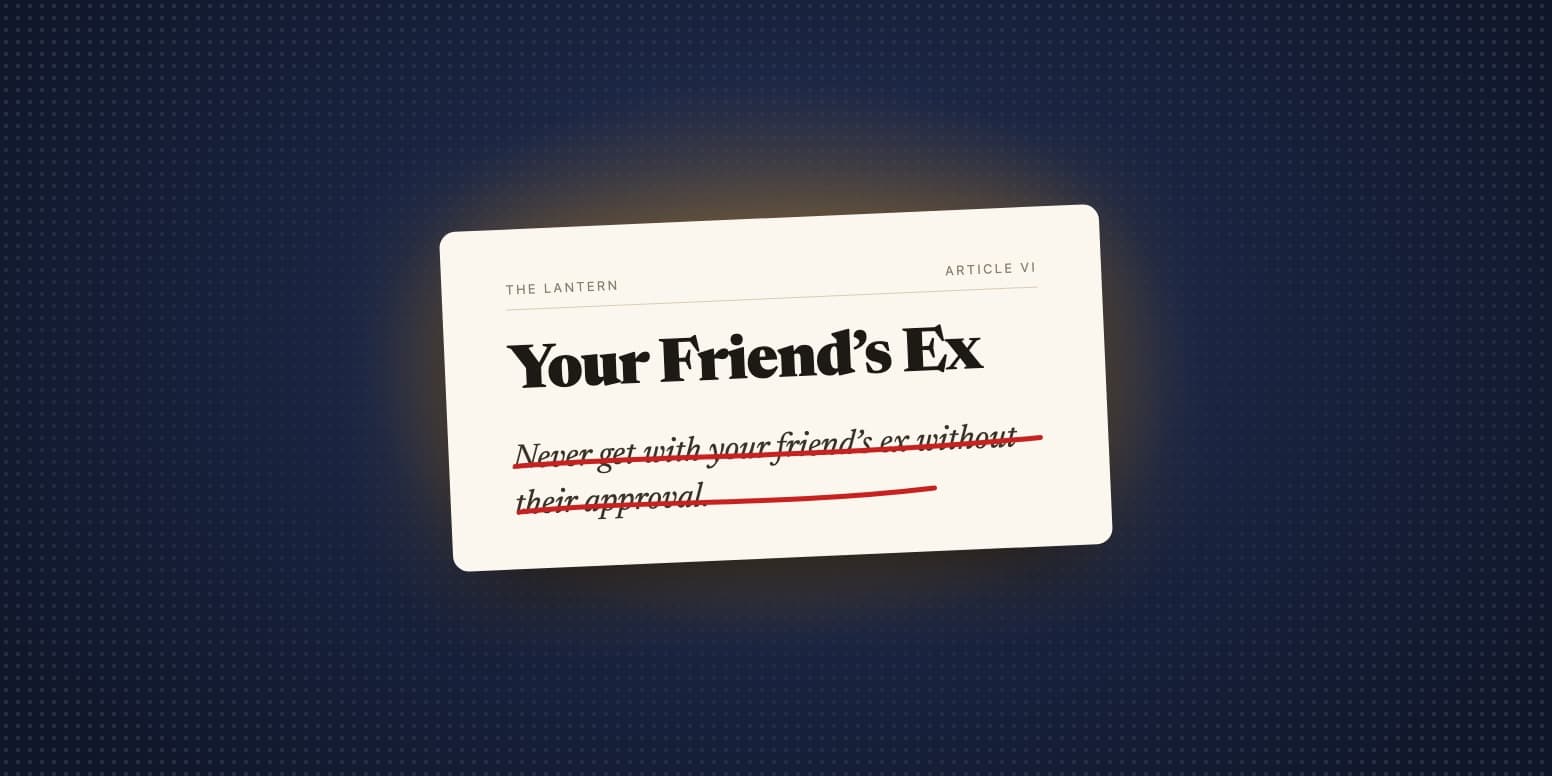
Article VI: Your Friend’s Ex. A man can never get with his friend’s ex-girlfriend without prior approval if the relationship cooldown period hasn’t passed. The same rule applies to your ex-girlfriend’s friends. It never ends well.
The Cooldown Equation: Cooldown (in months) = L × A × F × W. If the cooldown is longer than the time since the breakup, you need your friend’s approval.
- L, relationship length, in months
- A, age: high school 1.75, early college 1.25, late or post college 1.0, late twenties and up 0.75
- F, friendship: best friends 2.0, then 1.5, 1.0 and 0.5
- W, weight: casual 0.5, dated but not real 1.0, serious or messy 1.5, very serious 2.0
My thinking was that earlier relationships should wait a little longer, college a little longer too, and as you get into real life the length of the relationship starts to matter a little less. There had to be some consideration for how close you are with your friend. All of that made sense on a high level, so I just gave it numbers.
I told my brother it was completely fine for him to like his friend’s ex, with the caveat that as a good friend he might want to have a conversation with him before doing anything. He went on to start dating her, and they’ve been together since. For reference, he’s now a senior in high school, so this was always going to be a bigger deal than it was in reality. Still, it felt like an early form of success for something I wasn’t looking for success from. Despite years of a notes document for my future kids, this was the first time any of it had actually been useful to someone, even if it would need some revision.
So when I was thinking about what to get my brother for Christmas that year, I had the brilliant idea of taking the book out of Google Docs and printing it.
That’s around when I landed on the name: The Lantern is meant to light your path through life, helping you see the patterns, traps and shortcuts before you walk into them. Super cheesy, I know, but it felt cheesy enough for something reminiscent of Barney’s Playbook or the Bro Code, and I stuck with it.
After some short revisions once I arrived home again from Barcelona, I printed five copies of Volume 0 and I kept it a complete secret. I wanted to surprise my brother with it and give him all eighty or so articles I’d accumulated abroad. The other four went to my sister’s boyfriend, two friends from home, and one for me. I engraved a little note for my brother in the first page, too. In a way it felt like me talking to my younger self, doing what I’d always wanted to do with the notes document for my kids, except I’d found a way to do it in the present.
As I caught up with friends and read my funny creation with them over drinks, a lot more people than I expected wanted their own copy. So I added what was always meant to be the point to the author’s note: new versions of the Lantern exist so I can see how my thinking grows and changes over time. I didn’t want it taken too seriously, or to be some marker of who I am. I wanted it to be checkpoints of where my thinking was. I wanted it to make people think about their own situations. Not to give you the answers, but to give you a take, so you’d have an opinion of your own about it and that would make you think. I really underestimated the value of that, and I think it’s where a lot of the gold lies in something like this.
After a lot of time with friends that December, I wrote two more versions, Version 1 in January and Version 2 in February, and handed them to around 25 different friends. I left the last two pages completely blank, with a note asking whoever had the book to write down any changes they’d make, and to send me all of them by November 2026 so they could be considered for the next version.
I remember very vividly thinking in December 2025 that the year had been so transformative that none of it could keep up. I didn’t think my life would change very much once I went back to Rice. I thought I had reached the end of that change, and boy could I not have been more incorrect.
If 2025 was the year of change and self-discovery, 2026 was learning more than I ever had before and applying it to my life at a much faster scale. I started writing movie scripts. I started a more formal book called The Tree of Human Flourishing. I took philosophy classes and computer ethics classes. I explored so many areas that took me in so many directions that I never really had the time to think about the original book I’d written. It could exist as a sort of prop, a really fun thing to read with your friends, especially after a few drinks.
At some point this summer, while I was working at Google, I reread Article VI, Your Friend’s Ex. My first thought was, “I totally can’t say something this objective.” It’s so much more subjective than that. There are so many more reasons that make something “a problem” for you, for your friend, and for your friendship, and saying some equation exists for that was implausible. I noted in my vault that I wanted to rewrite it, maybe as a philosophical essay examining exactly that question. I never got to it.
Meanwhile people kept texting me about it. Friends gave it to other friends at their universities. One friend told me his copy had been passed to something like five different people going through relationship problems who “needed the book”, and he doesn’t even know who has it now. That was such an honor to me, that something I made could become that. But more than that, I felt a sense of responsibility, because I’m showcasing my thinking now. As I repeatedly learn, no one ever reads the author’s note. No one reads that this isn’t something to take with 100% certainty, that it’s supposed to grow and change. You interpret what you read to the extent and reasoning with which you focus on it. If you want to learn maybe you’ll think about it, if you’re curious maybe you’ll think about it. When you’re looking at a piece of writing as unserious, and it states some very objective statement on something subjective, you don’t really think too much about it. You either disregard that information or just act on it because a book says to.
It also gave a lot of people a very extreme opinion of me, which, fair enough, I guess. It made me rethink how I wanted to shape something like this, because I understood a lot more about the people who were going to read it. I wanted it to have the effect How I Met Your Mother had on me, giving you that catharsis. In a small form, the original way had worked. It’s what made me want to write more subjective, further explored versions of some of the articles, like the one that prompted this one so it can serve as something funny but also lead you to thinking about yourself.
What I’ve noticed is that when your life is changing and moving this fast, slowing down to write these articles in a more specific way can take you out of the growth you’re going through. I didn’t consider that much in December, and I think that’s a direct result of what my thinking was then. I had done all this thinking. I had “arrived”. I had understood Aristotle’s eudaimonia and how to live my life well. I had reached a logic that isn’t correct, per se, but made a lot of sense to me, with more clarity than I’d ever had, and perhaps it shows in some of these articles from before. But I love having that written down as a signal of where I was. The most important thing to me is always my own growth, and applying that to living my life more the way I find I want. If correcting the book isn’t where my interests are leading in the moment, I don’t want to step out of where I’m going to act on that.
What I want most for Version 3 is a reference for where my mind has gone over time, so it can show the direction my thinking has moved and become a more effective version of that notes document I started so many years ago. I used to think that kind of record needed a major shift in my thinking, or a moment where I felt I had answers. Now I see I can keep it on a much smaller scale, every single day. It’s part of why the Lantern grew into EVÐA. I now get to watch my thinking change and grow, and to see the patterns I get myself into that I could never see directly, and act on changing the thoughts that affect me every day that influence my wellbeing as well as every situation I get myself into.
I’m often asked, “Do you think people can change?” I never understood that question, because for me it has always been an emphatic yes, even before I had undergone a change of my own. At times the question is really asking if somebody can be a person that fits somebody else’s standards. Perhaps the change a person can make is becoming more of themselves. The idea that you can’t change, that you are some person who has xyz wrong with them just seems like such a big self imposed limitation. What I’ve gotten from noting my thoughts every day is the realization of how much more complicated I am, and how much more complicated every situation truly is. Whether it’s a book you feel you could write, a notes document or a daily journal, I believe it’s one of the most valuable things you can do for yourself to just take that step. It’s impossible to see so much of our own lives without it. I believed during many points in my life that doing what I’m doing now would be completely worthless because I thought I was a lost cause. That there was no fixing me. But if I had never taken one step to just do more of what I believed I wanted to do, even something as ridiculous as writing a version of Barney’s Playbook, I’m not sure I would have been able to be anywhere close to who I am becoming every day. I know that if somebody gave me my own product two years ago, I probably wouldn’t even want to use it. That’s also why I don’t think anyone can really prescribe to you what is best to do next in your life. I think the most concrete way to regain that control and agency of your own life is by just taking the first step to do so: the first step towards yourself. And when you do take that step, in whatever twisted form it may appear as, just feel it and continue going in whichever ways that may be.
In that original notes document, in seventh grade, I quoted Albert Einstein: “Everyone is a genius, but if you judge a fish by its ability to climb a tree, it will live its whole life believing that it is stupid.” Perhaps I already understood the very thing that led me to need a major change all the way into college. We judge people, and ourselves, by criteria that aren’t right for them, and nobody else can know what the right ones are. The only way to judge yourself by the right criteria is to use the ones you truly have for yourself, see if they make sense and feel good, and revise.
I stole another quote from my seventh grade self too: “A year from now you’ll wish you started today.” I believe that more than ever.
I misunderstood a lot back in December 2025, but one of the core things I did understand was that I may be wrong in my thinking right now and maybe that was the most important thing to understand. That’s what the equation was. It was wrong, and it was still good enough for my brother to have the conversation and make his own call.
So apologies, but the question of your friend’s ex is still open. If you have a copy, you have until November. If you don’t, text me and I’ll try to get you one. Take that information for what you will, and go live the life you truly want to live.
P.S. Can’t wait to see how much I’d change about this in a year’s time... in all fairness, I’ve found there can be a tremendous amount of impact in not perfecting every word, but instead just showcasing how you feel, because if you do it right, other people can feel that too. Hopefully this gave a decent showcase of that.
Enjoyed this? Get an email when I publish.